
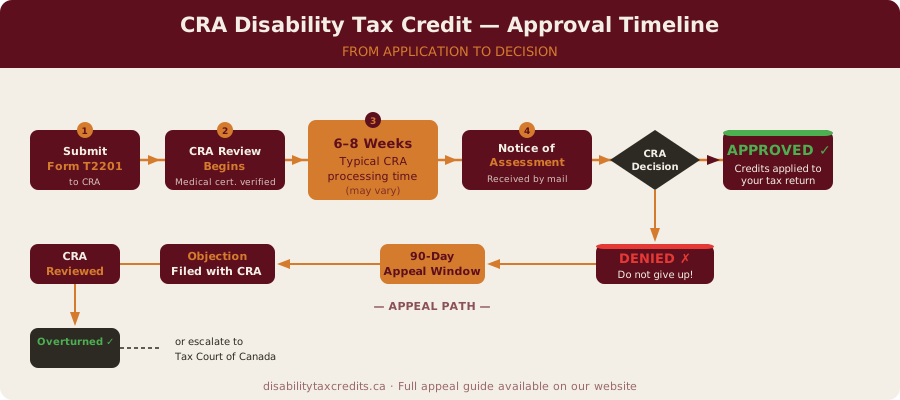
The Complete T2201 Processing Timeline
Let's walk through exactly what happens from the moment your T2201 leaves your hands to the moment CRA issues its decision. This is the typical trajectory for a straightforward application submitted in 2026.
Form Submitted
You mail or upload your completed T2201. If uploading via CRA My Account, you'll receive a confirmation number. Keep this. If mailing, use tracked mail and keep your tracking number and a photocopy of the form.
CRA Receives and Logs the Form
Paper submissions are received and sorted at CRA's tax centre. Digital submissions are typically logged within 24-48 business hours. You may see "received" or "in progress" appear in your My Account document status.
Medical Review by CRA Assessor
A CRA assessor, not a medical professional, reviews the clinical information in Part B. They are checking whether the documented restrictions meet the statutory criteria. This is the longest part of the process. If the assessor needs clarification, they may contact your medical practitioner directly (this is why you sign the consent in Part A).
Decision Made, Notice Prepared
The assessor makes a determination: approved, partially approved, or denied. CRA prepares a Notice of Determination. This is typically mailed to your address on file and may also appear in My Account.
Notice of Determination Received
You receive the official decision. If approved, CRA may reassess the tax years indicated on Part A. Any refund timing depends on CRA processing and the details of each return.
Factors That Affect Processing Time
Not every application moves at the same speed. Here's what can accelerate or slow your file:
Factors That Speed Things Up
- Digital submission via CRA My Account, Avoids mail delays and is logged faster.
- Clear, detailed Part B documentation, Fewer questions from the assessor means no back-and-forth with your practitioner.
- Submitting outside of peak season, May through September is typically faster than February through April.
- Straightforward condition with objective evidence, Vision acuity measurements or audiological test results are harder to question than subjective pain scales.
Factors That Slow Things Down
- Peak tax season (Feb-April), CRA processes enormous volumes; expect 10-12 weeks rather than 6-8 during this window.
- Vague or incomplete Part B, If the assessor needs to contact your practitioner for clarification, add 2-4 more weeks minimum.
- Complex or unusual conditions, Applications involving less-common conditions may be escalated for additional review.
- Missing information in Part A, An incomplete Part A can result in CRA mailing back the form to you, resetting the clock entirely.
- Retroactive claims covering many years, More years to reassess means more time for CRA to process refunds after approval.
How to Check Your Application Status
You have two options for checking where your T2201 stands:
Option 1: CRA My Account (Recommended)
- Log into CRA My Account
- Navigate to "Benefits and Credits" → "Disability Tax Credit"
- Or check "Submit documents" for the status of your uploaded T2201
Status messages you may see: "Received," "In progress," "Under review," "Decision made." Once you see "Decision made," check your mail for the formal Notice of Determination.
Option 2: Call CRA Directly
Call CRA's individual tax inquiries line at 1-800-959-8281. Hours are Monday-Friday, 8 am to 8 pm local time. Have your SIN ready, plus the date you submitted the T2201. A CRA agent can confirm receipt and give you a timeline estimate.
What Different CRA Responses Mean
When the Notice of Determination arrives, it will say one of three things:
1. Approved
The CRA has accepted that you meet the eligibility criteria for the DTC. The notice will specify the years for which you're approved. CRA may then reassess those tax years; any refund or adjusted assessment depends on tax payable, approved years, and transfer rules. Going forward, you can claim the DTC on line 31600 of your annual return, or have it transferred to a supporting person on line 31800.
Important: approval is often period-specific. CRA may approve you for certain years only, or set a review date in the future (e.g., "approved until December 2028, at which point a new T2201 may be required").
2. Partially Approved / Approved with Conditions
Less common, but CRA may approve you for some years but not others, or for a shorter period than requested. Review the notice carefully to understand exactly what was approved. You can appeal the denied portion if you believe you qualified for those years.
3. Denied
CRA determined your impairment does not meet the eligibility criteria based on the information provided. This may mean the documentation did not clearly show how the restriction meets CRA's test. You have 90 days from the date of the notice to file a Notice of Objection. See our complete appeal guide for the step-by-step process.
What to Do If You're Delayed Past 8 Weeks
Eight weeks have passed. Nothing. Here's your action plan:
- Check CRA My Account first. Sometimes the notice is available digitally before it arrives in the mail.
- Call CRA at 1-800-959-8281. Ask for the status of your T2201 application. If they can't find it, there may have been a mail issue.
- If the form was lost: Ask CRA to confirm their mailing address, then resubmit. This time, use tracked mail or digital upload through My Account.
- If it's confirmed in progress: Ask for an estimated completion date. During peak season, CRA agents can usually give you a rough timeframe.
- Document everything: Note the date and time of your call, the name or ID of the agent you spoke with, and what they told you. This creates a paper trail if issues arise later.
After Approval: What Happens Next
Approval triggers a series of CRA actions automatically. Here's what to expect:
- Tax reassessments: CRA will reassess each year you indicated on the T2201. You'll receive a Notice of Reassessment for each year, this is normal and expected.
- Refunds: Any tax you overpaid in prior years (because you didn't claim the DTC) will be refunded, usually within 2-4 weeks of each reassessment. These can come as direct deposits or cheques.
- Future returns: You can now claim the DTC on line 31600 of each year's tax return going forward, until the period CRA specified in the Notice of Determination.
- Child Disability Benefit: If the DTC is for a child under 18, the CDB will also be recalculated. This can result in additional back-payments.
Frequently Asked Questions
The typical processing time is 6 to 8 weeks from the date CRA receives your completed T2201. During peak season (February-April), this can stretch to 10-12 weeks. Digital submissions through CRA My Account tend to be slightly faster than paper mail submissions.
Log into CRA My Account and check "Benefits and Credits" → "Disability Tax Credit" or your "Submit documents" section. You can also call CRA directly at 1-800-959-8281. Have your SIN and the date you submitted ready.
"Under review" means a CRA assessor is actively reviewing your T2201. This is completely normal, it doesn't signal a problem. Most "under review" applications resolve within the standard 6-8 week window.
Call CRA at 1-800-959-8281 to check status. Confirm they received your form, and ask for an estimated timeline. If the form was lost in transit, you may need to resubmit, which is why keeping a photocopy and using tracked mail is important.