
Quick Answer
To qualify for the Disability Tax Credit in Canada, you must have a severe and prolonged impairment in physical or mental functions that markedly restricts a basic activity of daily living, or you require life-sustaining therapy for 14 or more hours per week. The impairment must last, or be expected to last, at least 12 consecutive months and be certified by a medical practitioner on Form T2201.
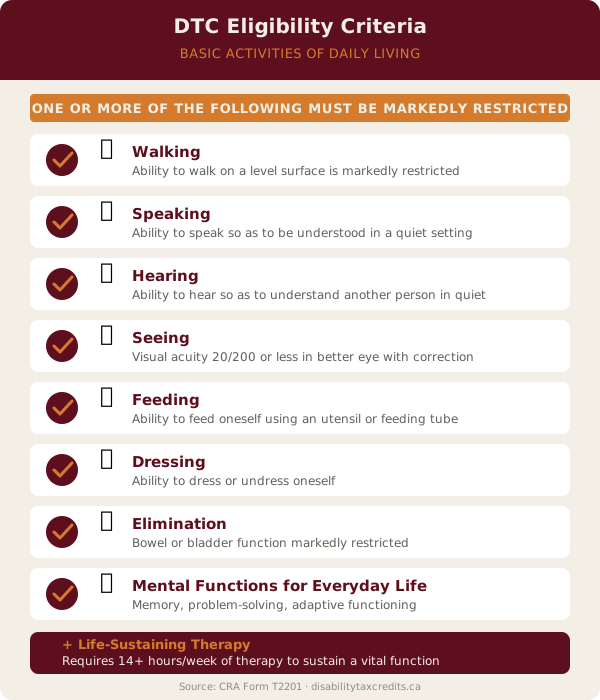
Understanding the Two DTC Eligibility Pathways
To qualify for the Disability Tax Credit, you must meet at least one of two pathways as defined by the Income Tax Act and the CRA:
The 8 Basic Activities of Daily Living
The CRA defines the following as basic activities of daily living (BADL) for DTC purposes. A restriction in any one of these, or a cumulative restriction in two or more, may qualify you.
Vision
Even with corrective lenses, you cannot see well enough to perform daily tasks. Legal blindness (visual acuity 20/200 or worse in the better eye) typically qualifies.
Speaking
You are unable to communicate orally in a way that another person can understand, even with assistive devices.
Hearing
Even with a hearing device, you cannot hear well enough to understand another person in a quiet setting. Profound deafness typically qualifies.
Walking
Even with appropriate devices, you cannot walk 100 metres on a level surface or climb 5 stairs without stopping due to breathlessness, pain, or lack of coordination.
Eliminating (Bowel or Bladder Functions)
You are markedly restricted in your ability to control or manage bowel or bladder functions, requiring excessive time or assistance.
Feeding
You require an inordinate amount of time to feed yourself, or are unable to do so without assistance. Note: preparing food is excluded, only the act of eating.
Dressing
You require an inordinate amount of time to dress and undress yourself, or are unable to do so without assistance.
Mental Functions Necessary for Everyday Life
You are markedly restricted in memory, problem solving, goal setting, or judgment. This covers many mental health and cognitive conditions including autism, depression, PTSD, and acquired brain injuries.
The "All or Substantially All" Rule, The 90% Standard
A basic activity is considered markedly restricted only if the restriction exists at least 90% of the time. This means:
- The restriction is present most days
- It applies even with appropriate therapy, medication, or devices
- Occasional good days do not disqualify you, the overall pattern matters
The Prolonged Requirement: 12+ Months
To qualify, your impairment must be prolonged, meaning it has lasted, or is reasonably expected to last, for a continuous period of at least 12 months.
- Temporary conditions (e.g., broken leg) do not qualify
- Chronic conditions that meet the 12-month threshold typically qualify
- The condition does not need to be permanent, just expected to last 12+ months
- Once approved, you may be eligible for multiple years retroactively
The Cumulative Effect Rule
If you have significant, but not "markedly restricting", limitations in two or more basic activities, the combined (cumulative) effect may still qualify you for the DTC.
For example, someone who is moderately restricted in both walking and mental functions, where neither alone qualifies, may still meet the DTC criteria through the cumulative effect. Your medical practitioner must certify this on T2201.
Pathway 2: Life-Sustaining Therapy
The life-sustaining therapy pathway was specifically created to include conditions like Type 1 Diabetes. To qualify:
- The therapy must be required to support a vital function (e.g., insulin administration)
- It must be required at least 3 times per week
- It must total at least 14 hours per week (including time for preparation, administration, and recovery)
- A medical practitioner must certify it is essential to sustain a vital bodily function
Medical Practitioner Types for T2201 Certification
The type of medical professional who can certify your T2201 depends on the nature of your impairment:
| Impairment Type | Eligible Certifiers |
|---|---|
| Vision | Medical doctor, optometrist |
| Hearing | Medical doctor, audiologist |
| Speaking | Medical doctor, speech-language pathologist |
| Walking | Medical doctor, physiotherapist, occupational therapist |
| Feeding & Dressing | Medical doctor, occupational therapist |
| Eliminating | Medical doctor, nurse practitioner |
| Mental Functions | Medical doctor, psychologist, nurse practitioner |
| Life-Sustaining Therapy | Medical doctor, nurse practitioner |
| All impairments | Medical doctor, nurse practitioner |
Children Under 18 and the DTC
Children under 18 may qualify for the DTC and the child supplement:
- The 2026 child supplement is $6,032 (credit value: $845)
- The same eligibility criteria apply as for adults
- Parents or guardians complete Part A of T2201 on the child's behalf
- A medical practitioner certifies Part B based on the child's impairment
- The credit is typically transferred to the parent or supporting person
Credit Transfer Rules
If the person with the disability does not need the full DTC credit to reduce their taxes to zero, the unused portion can be transferred to a supporting person, including:
- Spouse or common-law partner
- Parent or grandparent
- Child or grandchild
- Sibling, aunt, uncle, niece, or nephew
The supporting person must have provided financial support during the year. The caregiver amount for 2026 is $8,773 (federal).
For your specific situation, including how a transfer affects both your own and the supporting person's return, consult a qualified Canadian tax professional or the CRA.
Qualifying Conditions
The DTC is condition-neutral, it is based on the functional impact of the condition, not the diagnosis. However, certain conditions have well-established DTC eligibility pathways:
Common Reasons for DTC Denial
The CRA may deny a DTC application for the following reasons. Understanding these can help you avoid common mistakes:
- Condition doesn't meet "markedly restricts" standard, The impairment must be present at least 90% of the time
- Less than 12 months, The condition must be prolonged
- Incomplete T2201, All required sections must be filled in by the appropriate practitioner
- Wrong certifier, Only the correct practitioner type can certify the relevant impairment
- Insufficient clinical detail, Vague descriptions by the medical practitioner may lead to denial
- Life-sustaining therapy doesn't meet 14 hours/week, Must be calculated carefully and documented
The Income Tax Act Foundation
The Disability Tax Credit is created by section 118.3 of the federal Income Tax Act. The statute defines who qualifies, the medical certification requirements, the calculation method, and the rules for transferring unused credit to a supporting family member. Every CRA decision on a Disability Tax Credit application can ultimately be traced back to this single section of the Act.
Section 118.3 also defines the appeal process when CRA denies a claim. A taxpayer who disagrees with a Notice of Determination has the right to file a Notice of Objection under section 165 of the same Act, which moves the file to CRA's Appeals Division for independent review. The Tax Court of Canada is the final level of appeal after the CRA Appeals Division process is exhausted. The full Income Tax Act is published by the Department of Justice Canada at laws-lois.justice.gc.ca, and our DTC glossary defines the most-used statutory terms in plain English.
The DTC Application Process, Step by Step
The application process is the same for every Canadian, regardless of province. The seven-step path from a first conversation with a medical practitioner to a Notice of Determination typically takes between 8 and 16 weeks, though more complex files can take longer.
- Decide which eligibility path applies: marked restriction in a single basic activity, cumulative effect across multiple restrictions, or life-sustaining therapy of 14 or more hours per week.
- Find a qualified medical practitioner for your category. A medical doctor or nurse practitioner can certify any category. Psychologists, optometrists, audiologists, physiotherapists, occupational therapists, and speech-language pathologists can certify within their scope. Our medical practitioner DTC guide explains which certifier types can complete each category.
- Complete Part A of form T2201 yourself or through a supporting person. Part A captures identifying information and the tax years being claimed.
- Have Part B completed by your medical practitioner. Part B is the medical section and is where eligibility is established. Our T2201 application guide walks through Part B page by page.
- Submit the completed T2201 to CRA, either by mail to the Sudbury Tax Centre or by uploading through CRA My Account. Digital submission is faster.
- Wait for the Notice of Determination. CRA reviews the application and issues a decision in writing. The Notice states whether the credit is approved, for which tax years, and any expiry date for re-certification.
- Claim the credit on your tax return. Once approved, the federal portion is claimed on Schedule 6 of the federal return, and CRA applies the provincial portion automatically through the corresponding provincial Form 428 (except in Québec, which requires a separate provincial form).
Programs Connected to DTC Approval
The federal Disability Tax Credit can reduce federal tax payable by approximately $1,448 per year, before any provincial credit value is considered. The bigger financial picture may come from federal benefits connected to DTC approval. None of these are automatic, and each has its own income test and application process, but DTC approval may be required before accessing each program.
The Child Disability Benefit pays up to $3,411 per year for a DTC-approved person under 18, added automatically to the Canada Child Benefit. The Registered Disability Savings Plan allows up to $200,000 in lifetime contributions and may provide access to up to $90,000 in federal grants and bonds over a beneficiary's lifetime when program rules are met. The Canada Disability Benefit launched in July 2025 and may pay up to about $200 per month to working-age adults aged 18 to 64 with DTC approval, subject to income testing and program rules. The Home Accessibility Tax Credit provides up to $3,000 in federal tax relief on eligible renovations to a principal residence.
For families with a DTC-approved child, the combined value of the Child Disability Benefit plus the RDSP over the child's lifetime can exceed the headline DTC by an order of magnitude. See our benefits hub for full details on each program.
Provincial Portion: How It Varies Across Canada
The 2026 federal disability amount is $10,341, giving approximately $1,448 at the 14% rate before Quebec abatement. Provincial disability amounts and tax rates differ. Our rates guide shows rounded adult base-credit illustrations; child supplements, surtaxes and supplemental credits can change the final result. Quebec has separate provincial eligibility and federal abatement rules.
The provincial portion is applied automatically on your federal return through the corresponding provincial Form 428 (ON428 for Ontario, BC428 for British Columbia, and so on), with one exception. Québec residents must file Form TP-752.0.14 separately with Revenu Québec for the provincial credit, in addition to Form T2201 submitted to CRA. The CRA review and the Revenu Québec review are independent.
Beyond the dollar amount, each province has its own income-support program (AISH in Alberta, ODSP in Ontario, PWD in British Columbia, SAID in Saskatchewan, and equivalent programs in every other province and territory). The DTC and these provincial programs operate independently with separate eligibility tests, but DTC documentation is generally recognised by the agencies that administer the provincial programs. See our province rates hub for combined-credit figures and program details for all 13 provinces and territories.
Retroactive Claims: Up to 10 Years Back
If you qualified for the Disability Tax Credit in prior tax years but did not claim it, CRA allows retroactive adjustments for up to 10 prior years. The mechanism is form T1-ADJ (T1 Adjustment Request), filed separately for each prior tax year. CRA recalculates each year's tax payable with the DTC applied and refunds any overpaid tax for that year.
The Notice of Determination approving your DTC will normally specify the earliest tax year for which the credit is approved. That date is the boundary for retroactive adjustments. If your medical practitioner certifies on Part B that the impairment has lasted, or has been expected to last, since a specific year, that year is the earliest a retroactive claim can reach. The 10-year limit on T1-ADJ filings is a separate, harder ceiling regardless of how far back the impairment is documented.
Prior-year reassessments may create a tax refund or adjustment when the DTC went unclaimed for several years and tax was payable in those years. Our retroactive DTC claims guide walks through the T1-ADJ filing process, the order in which to file when claiming multiple years, and the interactions with provincial benefits like ODSP or AISH that may treat a large retroactive refund as one-month income.
How CRA Interprets the Statute
CRA does not enforce the Disability Tax Credit framework on its own reading of the Income Tax Act. The agency publishes its official interpretation of section 118.3 in Income Tax Folio S1-F1-C2, Disability Tax Credit. The folio is the document CRA reviewers use when assessing a T2201, and it is the most useful single reference for anyone preparing a Notice of Objection or trying to anticipate how a borderline claim will be assessed. The folio is published at canada.ca, Income Tax Folio S1-F1-C2.
Where the folio is silent or ambiguous, the binding interpretation is the case law of the Tax Court of Canada. Many DTC appeals have been decided under section 118.3, with outcomes that clarify how the marked restriction test, the cumulative-effect rule, and the life-sustaining therapy threshold apply in specific medical fact patterns. Tax Court decisions are published openly on the Canadian Legal Information Institute at canlii.org, Tax Court of Canada, where searching for "disability tax credit" plus an impairment category returns relevant cases. For a difficult appeal, reading a small number of decisions in your specific fact pattern is one of the most valuable preparation steps.
A Brief History of the Disability Tax Credit
The Disability Tax Credit was introduced in 1988 to replace a more limited deduction that had existed earlier in the Canadian tax system. The original credit covered a narrower set of impairments, with significant expansions in 2000 (extending eligibility for life-sustaining therapy and recognising mental functions as a distinct category) and again in 2005 (formalising the cumulative effect rule). The federal basic disability amount has been indexed annually for inflation, rising from approximately $4,118 in 2000 to $10,341 in 2026.
The wider DTC framework has continued to expand. The Registered Disability Savings Plan was added in 2008, the Home Accessibility Tax Credit (HATC) for renovations was added in 2016, and the Canada Disability Benefit launched in July 2025. Each of these federal programs is anchored to DTC approval, which is one reason the credit matters far beyond its $1,448 federal dollar amount.
After Approval: Next Steps and Renewals
The Notice of Determination approving the Disability Tax Credit will state whether the approval is permanent or whether re-certification is required at a future date. Many approvals are open-ended for permanent impairments. Others, particularly for conditions where CRA expects recovery or change over time, carry an expiry date requiring a new T2201 in a future year.
Once approved, the next steps are practical. File T1-ADJ for any retroactive years you qualified for and did not previously claim. Open a Registered Disability Savings Plan at any major Canadian bank if you have not already, and begin contributing strategically to capture the Canada Disability Savings Grant match. If the approved person is under 18, the Child Disability Benefit will begin automatically with the next Canada Child Benefit payment cycle. If the approved person is between 18 and 64, apply for the Canada Disability Benefit through Service Canada.
If your medical situation changes meaningfully, either improvement or deterioration, notify CRA. Improvement may end eligibility for future tax years; deterioration may change which restrictions apply and which BADL categories are documented. CRA can re-review a file at any time, and the Notice of Objection process under section 165 is available for any future determination you disagree with.
Frequently Asked Questions
The CRA considers a basic activity "markedly restricted" if you are unable to perform it, or take an excessive amount of time compared to someone without the impairment, even with therapy, medication, and appropriate devices. This must be the case at least 90% of the time.
If no single activity is markedly restricted, but you have significant restrictions in two or more basic activities, the cumulative effect can still qualify you. Your medical practitioner must certify the combined impact on T2201.
At least 12 consecutive months. The impairment must have lasted, or be expected to last, for a continuous period of at least 12 months.
It depends on the type of impairment. Medical doctors and nurse practitioners can certify all types. For specific impairments, other practitioners (optometrists, audiologists, psychologists, physiotherapists, occupational therapists) can certify the relevant sections. See the table above for details.
YMYL disclaimer. This guide is educational only and does not constitute medical, tax, legal, or financial advice. Disability Tax Credit eligibility is determined by the Canada Revenue Agency on a case-by-case basis using the criteria set out in section 118.3 of the Income Tax Act. Always confirm eligibility with a qualified medical practitioner and consult a tax professional before filing. Provincial revenue ministry rules apply separately for the provincial portion of the credit.