
Why Retroactive Claims Exist, and Why So Many Canadians Leave Money Unclaimed
Here's something that surprises most people: CRA doesn't come looking for you. If you qualified for the Disability Tax Credit in 2019 but didn't know about it, CRA will not proactively send you money. The burden is entirely on the taxpayer to apply, and to go back and claim years they missed.
This creates a massive gap. According to advocacy estimates, hundreds of thousands of eligible Canadians have never claimed the DTC. Many learned about it years into their disability. Others were told incorrectly by doctors or accountants that they "wouldn't qualify." And many simply didn't know the retroactive window existed.
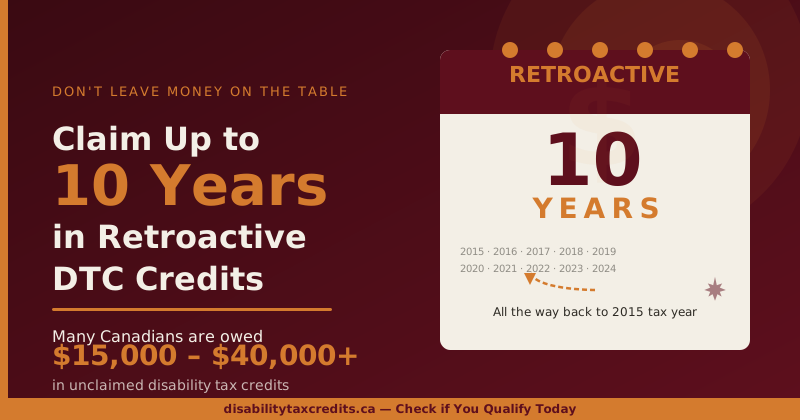
The good news: you have up to 10 years to go back and claim. For someone who qualified in 2016 and is filing in 2026, that's potentially a decade of unclaimed credits, often worth tens of thousands of dollars.
Real Examples: What Retroactive Claims Can Look Like
Oscar's Story, $69,000 Over 10 Years
Oscar had Type 1 diabetes and had been managing his condition for over 12 years. He'd never heard of the Disability Tax Credit. When he finally applied and was approved, his 10-year retroactive claim, including both federal and Ontario provincial credits, came to approximately $69,000 in combined refunds and reassessments. This included Child Disability Benefit adjustments for the years his son also had T1D; families with similar facts can compare the condition criteria in our diabetes DTC guide.
Yadinesh's Story, $36,000 Over 8 Years
Yadinesh was diagnosed with schizophrenia in 2017. His family hadn't known about the DTC until a social worker mentioned it in 2025. His approved T2201 covered the years 2017-2025. The retroactive claim, combining federal and Alberta provincial credits with a caregiver transfer to his father for the early years, totalled approximately $36,000.
Which Years Can You Claim Retroactively
The 10-year rule means: in 2026, you can request adjustments to tax years 2016 through 2025. The rule is technically "10 years from the later of your filing due date or the date the return was filed," but in practice, most tax professionals use a straightforward 10-year lookback.
Key conditions for a retroactive claim to work:
- Your T2201 must cover the years you're claiming, your medical practitioner identifies the "start date" of your impairment in Part B.
- You must have had Canadian federal income tax payable in those years. (If you paid no tax, there's no credit to recover, the DTC is non-refundable.)
- If you had no personal tax payable, you may still be able to transfer the credit to a supporting person who did.
The Math: How Retroactive Amounts Are Calculated
Let's do the actual arithmetic so you understand what's at stake. Here are two worked examples:
Example 1: Federal-Only Estimate (Adult, No Supplements)
Annual federal DTC value (2026): $1,448 (14%× $10,341)
Years qualifying: 10 years (2016-2025)
Note: Prior years have slightly lower amounts due to indexing. We use an estimated average of $1,350/year for older years.
Rough federal estimate: $1,350 × 10 = $13,500 federal refund
(This is a rough estimate, actual amounts are calculated at each year's indexed rate)
Example 2: Federal + Ontario Provincial (Adult)
Annual combined DTC value in Ontario (2026): $1,978 ($1,448 federal + $530 provincial). See the Ontario DTC rates guide for the current provincial breakdown.
10-year estimated refund at average $1,900/year: $19,000 combined
Example 3: Alberta, Adult with Caregiver Transfer
Annual combined DTC value in Alberta (2026): $2,853 ($1,448 federal + $2,100 provincial). See the Alberta DTC rates guide for the current provincial breakdown.
If the DTC is transferred to a supporting parent: they claim the credit on their return
10-year estimated total at average $3,200/year: $32,000 combined
These numbers explain how Oscar's claim reached $69,000, he had child supplements, caregiver amounts, and two people with T1D in the household, with the claims occurring in a higher-rate province over a full 10 years.
The T1-ADJ Process: Step by Step
Once your T2201 is approved, the retroactive claim process works like this:
- Confirm your T2201 covers the years you want to claim. Check the Notice of Determination, it will specify the start date CRA has accepted. If the start date is 2018, you can't retroactively claim 2016 without a new or amended T2201.
- Download Form T1-ADJ (Request for Adjustment). Available from CRA's website. You'll need one form for each tax year you want to adjust. If you're claiming 8 years, that's 8 T1-ADJ forms.
- Complete each T1-ADJ. For each year, you'll change line 31600 (Disability Amount for self) from $0 to the applicable DTC amount for that year. CRA publishes historical disability amounts on their website.
- Attach supporting documentation. Include a copy of your approved T2201 (Notice of Determination) with each T1-ADJ. CRA already has the form on file, but including it speeds up processing.
- Submit the T1-ADJ forms. You can mail them to your tax centre, or submit them digitally through CRA My Account under "Submit documents." Digital is recommended.
- Wait for Notices of Reassessment. CRA generally processes each year separately. Processing times vary, and you should receive a Notice of Reassessment for each adjusted year showing any resulting credit or refund.
- Receive your refunds. Refunds are typically direct-deposited to your bank account on file with CRA, or mailed as cheques, within 2-4 weeks of each reassessment.
What Documentation Do You Need
The core documentation requirement is simple:
- Your approved T2201 / Notice of Determination (CRA may already have this on file)
- Completed T1-ADJ for each year being adjusted
- Your original tax returns for each year (not required to submit, but useful for your own calculation)
For caregiver transfer retroactive claims, you'll also need Schedule 2 completed for each year showing the supporting person's information and the transfer amount. If the supporting person (parent, spouse) is claiming the transferred credit, their returns also need to be adjusted.
How Long CRA Takes to Process Retroactive Adjustments
Retroactive adjustments typically take longer than a fresh tax return, plan for 8 to 12 weeks per year, though CRA often batches the years together. You'll start receiving Notices of Reassessment as each year is processed, usually in chronological order from oldest to most recent.
During peak season (February-April), add 4-6 more weeks to these estimates. Submitting in summer or fall generally moves faster.
Frequently Asked Questions
CRA allows retroactive DTC claims for up to 10 years. For a 2026 filing, you can request adjustments back to the 2016 tax year, as long as you qualified in those years and your T2201 covers that period. You file adjustments using Form T1-ADJ.
You use Form T1-ADJ, Request for Adjustment, to revise your previously filed tax returns. You need one form per year being adjusted. Submit with a copy of your approved T2201 or Notice of Determination.
Not necessarily. If your existing approved T2201 covers the years you're claiming, you simply file T1-ADJ. If your medical practitioner identified a start date that covers those years, you're set. If the retroactive period extends before the T2201 start date, a new T2201 with an earlier start date may be needed.
Typically 8 to 12 weeks per year, though CRA often batches the adjustments and processes them together. You'll receive a Notice of Reassessment for each year. Refunds follow within 2-4 weeks of each reassessment.
Yes. An estate trustee can file a T2201 and T1-ADJ adjustments on behalf of a deceased person, provided the years fall within the 10-year window and the person qualified during their lifetime. This can result in significant estate refunds that benefit the heirs. Because estate filings carry their own deadlines and rules, consult a qualified Canadian tax professional or the CRA for your specific situation.