Quick Answer
You do not need to be a Canadian citizen or permanent resident to claim the Disability Tax Credit. You need to be a resident of Canada for income tax purposes, hold a Social Insurance Number (SIN), and have a severe and prolonged impairment certified on Form T2201. Whether a newcomer qualifies depends on tax residency, not the type of permit or visa they hold.
The 3 requirements that apply to everyone
Regardless of immigration status, the Disability Tax Credit (DTC) has the same three gates. Notice what is not on the list, Canadian citizenship and permanent residence:
- You are a resident of Canada for income tax purposes. This is a tax concept, not an immigration one (explained below).
- You have a valid Social Insurance Number (SIN). A temporary SIN (beginning with 9) is acceptable.
- A medical practitioner certifies a severe and prolonged impairment on Form T2201.
If those three are met, newcomers, temporary residents, and protected persons can all qualify. The full eligibility rules are in our DTC eligibility guide.
The one rule that decides everything: tax residency, not your visa
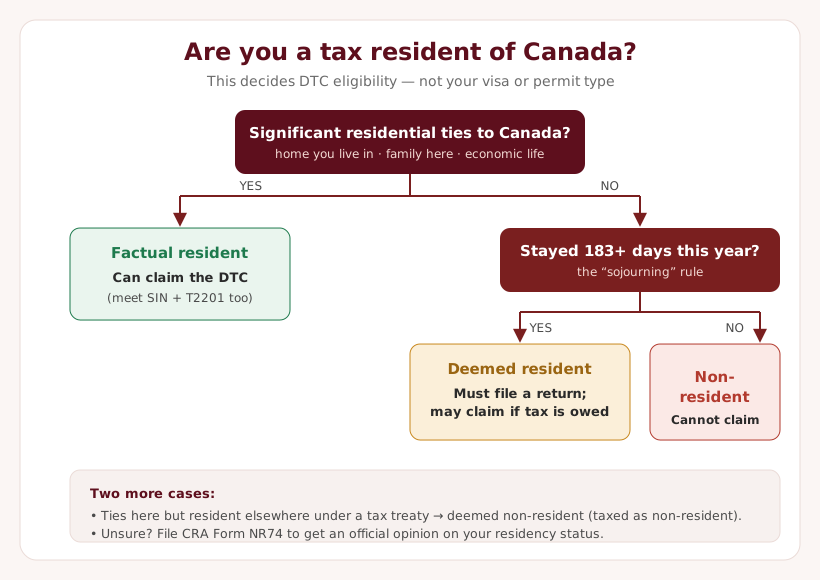
Your immigration status and your tax status are decided separately. A study permit, work permit, or super visa tells the CRA nothing on its own. What matters is your residential ties to Canada. The CRA recognizes four categories:
- Factual resident — you have significant residential ties (a home you live in, a spouse or dependants here, social and economic ties). Most newcomers who settle here fall into this group.
- Deemed resident — even without strong ties, if you stay in Canada 183 days or more in a calendar year, the CRA can treat you as a resident for that year.
- Non-resident — few ties and under 183 days. A non-resident cannot claim the DTC.
- Deemed non-resident — you have ties here but are treated as resident of another country under a tax treaty.
Only residents (factual or deemed) can claim the DTC. If your situation is unclear, CRA Form NR74 can be used to request an official opinion on residency status. For a deeper look at the residency test, see the CRA residency guidance.
What the DTC is worth in 2026
For 2026, the federal disability amount is $10,341, producing a federal credit of up to $1,448. Every province and territory adds its own credit, bringing the combined annual value to roughly $2,000 to $3,700 depending on where you live. A child under 18 adds a supplement worth about $845 more federally.
- See the full breakdown on the 2026 DTC rates page.
- Compare every province on the province rates hub.
- Estimate your own amount with the free DTC calculator.
The point for newcomers: these are the amounts a qualifying Canadian tax resident can recover. A visitor who is a non-resident with no Canadian tax recovers none of it, which is exactly why the next section matters.
Why "non-refundable" still puts money in your pocket
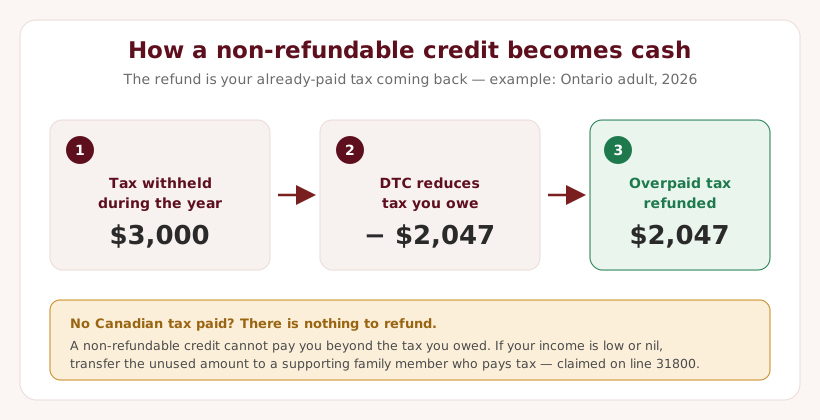
The DTC is a non-refundable credit: it reduces the tax you owe down to zero, but it will not pay you beyond that. The refund cheques people receive come from tax already withheld during the year being returned once the credit shrinks the bill. So if you paid no Canadian tax, the credit has nothing to refund to you directly.
That is why the transfer matters. An unused disability amount can move to a supporting family member you depend on, claimed on line 31800 under Income Tax Act section 118.3(2), who does pay tax. This single mechanism is why low-income newcomers and students still benefit, the credit is used by a working spouse, parent, or child instead.
Find your situation
The rules above apply to everyone, but the details differ by status. Choose the guide that matches yours:
Work permit holders
Usually the strongest case, you live and work here, hold a SIN, and pay Canadian tax, so the credit often becomes a real refund.
Study permit holders
Most degree students are tax residents and can claim, but with little income the value usually comes through a transfer to a supporting relative.
Super visa parents
Usually cannot claim directly, a super visa is a visitor status, so most parents are not tax residents and have no SIN. There are exceptions worth knowing.
Refugees & protected persons
Citizenship is not required. Protected persons and refugees can claim if they are tax residents with a SIN, and DTC approval may support access to the RDSP or Child Disability Benefit when tax residency, SIN, age, income, and program requirements are met.
Can a doctor outside Canada certify your T2201?
A diagnosis made overseas and authorization to certify the DTC are separate questions. CRA requires an appropriate practitioner who is authorized under the laws of the jurisdiction where the person being certified resides, or under the laws of a Canadian province. The practitioner's profession must also be permitted to certify the relevant impairment. Confirm authorization with CRA when residency or licensing is uncertain; do not assume that every foreign-trained practitioner is either accepted or excluded. See CRA's certification requirements.
Your medical records from abroad are still valuable, they serve as supporting evidence that a Canadian practitioner can review and rely on when completing the form, and they help establish when the impairment began for any future retroactive claim. See the statutory definition in ITA 118.4(2) and CRA's RC4064 guide.
DTC vs the Canada Disability Benefit, do not confuse them
The DTC is a tax credit. The Canada Disability Benefit is a separate program. For temporary residents it requires 18 months of temporary residence plus DTC approval. Being approved for the DTC does not automatically grant the Canada Disability Benefit, and a short-stay visitor will not meet the 18-month rule.
How to start
- Check whether you are a tax resident (residential ties, or 183+ days). Use Form NR74 if you are unsure.
- Make sure you have a SIN.
- Have an appropriately authorized practitioner complete Part B of the T2201 (the medical certification section), using your medical evidence and history from abroad. You fill out Part A (personal details); the practitioner certifies Part B.
- File or adjust your return, including any retroactive years in which you qualified as a Canadian tax resident.
Frequently Asked Questions
Yes. Citizenship and permanent residence are not required. You must be a resident of Canada for tax purposes, hold a SIN, and have a severe and prolonged impairment certified on Form T2201.
No. Tax residency is based on your residential ties to Canada, not your permit type. Immigration status and tax status are decided separately.
Often yes. The unused amount can transfer to a supporting family member who pays tax (line 31800), and DTC approval may support access to benefits like the RDSP and the Child Disability Benefit when program rules are met.
Check the practitioner's profession and authorization. CRA requires authorization where the person being certified resides or under the laws of a Canadian province. Overseas records can support an application; confirm uncertain licensing or residency cases with CRA.
No. It is a separate program with its own rules, including an 18-month temporary-residence requirement for temporary residents, plus DTC approval.