Disability Tax Credit Rates by Province, Canada 2026
Canada's most complete province-by-province DTC comparison. See estimated amounts where you live for all 13 provinces and territories, plus the federal and provincial benefits that DTC approval can support beyond the credit itself.
DTC Annual Credit, All 13 Provinces & Territories
Click any province for detailed rates, application information, and provincial programs.
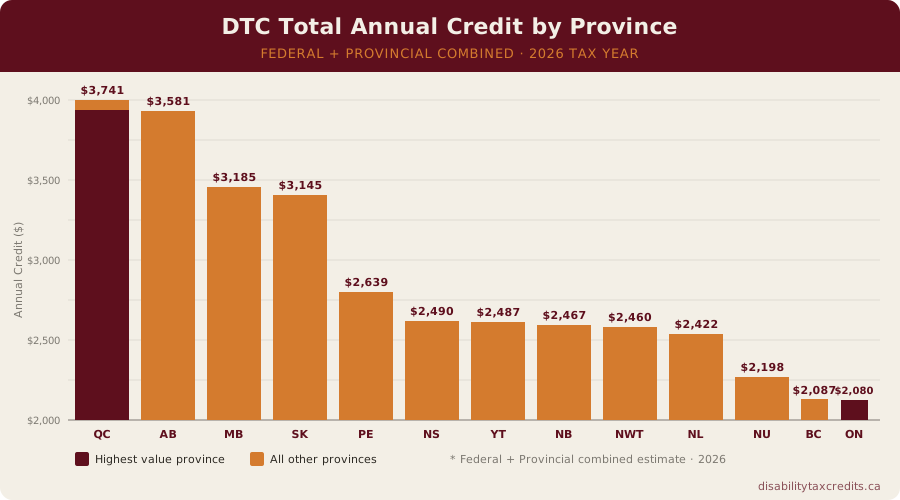
These are rounded adult base-credit illustrations, using published 2026 disability amounts and lowest tax rates. Provincial child supplements, surtaxes, supplemental credits and other tax-return adjustments are excluded. Tax payable limits apply. Quebec is calculated separately, including its federal abatement. Sources: 2026 provincial TD1 amounts and CRA tax rates.
Select Your Province
Provincial DTC Credit and Linked Benefits, 2026
The 2026 credit by province, plus the largest related federal or provincial benefit that DTC approval helps you access. Click a province name to open its full guide.
2026 estimates. Provincial credit values are based on each province's most recently published basic disability amount and lowest marginal tax rate. The federal base illustration is $1,448 before any Quebec abatement. Always confirm with your provincial revenue ministry before filing.
| Province / Territory | Federal (2026) | Provincial (2026) | Combined Adult Base | Amount source |
|---|---|---|---|---|
| Alberta | $1,448 | $1,405 | $2,853 | Official 2026 disability amount |
| British Columbia | $1,448 | $555 | $2,003 | Official 2026 disability amount |
| Manitoba | $1,448 | $667 | $2,115 | Official 2026 disability amount |
| New Brunswick | $1,448 | $960 | $2,408 | Official 2026 disability amount |
| Newfoundland & Labrador | $1,448 | $657 | $2,105 | Official 2026 disability amount |
| Northwest Territories | $1,448 | $871 | $2,319 | Official 2026 disability amount |
| Nova Scotia | $1,448 | $645 | $2,093 | Official 2026 disability amount |
| Nunavut | $1,448 | $669 | $2,117 | Official 2026 disability amount |
| Ontario | $1,448 | $530 | $1,978 | Official 2026 disability amount |
| Prince Edward Island | $1,448 | $655 | $2,103 | Official 2026 disability amount |
| Québec | Separate Quebec calculation; federal abatement and provincial eligibility apply. See guide. | |||
| Saskatchewan | $1,448 | $1,498 | $2,946 | Official 2026 disability amount |
| Yukon | $1,448 | $662 | $2,110 | Official 2026 disability amount |
How to claim. In every province except Québec, the provincial credit is applied automatically on your federal return via the provincial Form 428 (for example, ON428 for Ontario, BC428 for British Columbia). Québec residents also file form TP-752.0.14 with Revenu Québec for the provincial portion. AISH, ODSP, PWD, and SAID are separate income-support programs with their own medical eligibility, so DTC approval supports those applications but does not replace them.
Federal Benefits Connected to DTC Approval in Every Province
The provincial credit varies, but DTC approval also opens four federal programs that work the same in every province. These often add up to more than the credit itself.
- Child Disability Benefit (CDB). Up to $3,480 per year (July 2026 to June 2027) (2026, indexed annually) for a child under 18 with an approved T2201. Paid monthly with the Canada Child Benefit. Income-tested.
- Registered Disability Savings Plan (RDSP). Up to $3,500 per year in matching Canada Disability Savings Grant for low-income families, plus up to $1,000 per year in Canada Disability Savings Bond requiring no contribution. Lifetime contribution limit $200,000.
- Canada Disability Benefit (CDB). Up to $204.20 per month (July 2026 to June 2027) for working-age adults (18 to 64) with an approved T2201, launched July 2025. Income-tested.
- Home Accessibility Tax Credit (HATC). A separate non-refundable credit for qualifying accessibility renovation expenses. Check the current CRA rules for the tax year; the DTC calculator does not include this credit.
The combined value of these four federal programs can exceed the DTC itself, especially for families with a child or a low-income adult. The RDSP alone can deliver tens of thousands of dollars over a working lifetime when matching grants and bonds are claimed every year. See our Canada Disability Benefit guide and Child Disability Benefit guide for the income thresholds and how to enrol.
How to Claim the Provincial DTC
For 12 of 13 provinces and territories, the provincial DTC is claimed automatically on your federal return. CRA sees that you have an approved T2201 on file, then applies the provincial disability amount on the corresponding provincial Form 428 (for example, ON428 for Ontario, BC428 for British Columbia). You do not file a separate provincial form.
Québec is the one exception. Québec residents file Form T2201 with CRA for the federal DTC and Form TP-752.0.14 with Revenu Québec for the provincial credit. The medical criteria are similar, but the CRA review and the Revenu Québec review are independent. It is possible to be approved federally and denied provincially in Québec, though uncommon.
If you moved provinces during the tax year, your DTC rate is determined by your province of residence on December 31. You do not need to re-apply when moving; the approved T2201 is nationwide. See our T2201 form guide for step-by-step application help, or our DTC denied guide if a previous application was rejected.
Province Rate FAQs
Provincial disability amounts and lowest tax rates differ. The table shows rounded adult base-credit illustrations. Child supplements, surtaxes and supplemental credits are excluded; Quebec has separate rules, including federal abatement.
The federal claim amount is the same nationwide, but Quebec abatement changes the net federal tax saving. The 2026 federal base illustration is approximately $1,448 before abatement. Provincial disability amounts and credit rules also differ. You file one T2201 application with CRA for both federal and provincial credits (except Québec, which has a separate provincial process through Revenu Québec).
Quebec has separate provincial eligibility and filing rules through Revenu Quebec. The federal claim remains with CRA, and Quebec federal abatement affects the federal tax saving. Do not add an unadjusted federal amount to a provincial estimate.
Your DTC rate for a given tax year is based on your province of residence on December 31 of that year. You do not need to re-apply for the DTC when moving, your existing T2201 approval is valid nationwide.
DTC approval can be an eligibility requirement for several federal programs, but each program has its own rules. The Child Disability Benefit pays up to $3,480 per year (July 2026 to June 2027) for an approved person under 18. The Registered Disability Savings Plan (RDSP) provides up to $3,500 per year in matching grants plus up to $1,000 per year in bonds for low-income families. The Canada Disability Benefit may pay up to $204.20 per month (July 2026 to June 2027) to working-age adults, subject to income testing and program rules. The Home Accessibility Tax Credit has separate year-specific rules for eligible renovations and is excluded from this calculator.
In every province except Québec, the provincial DTC is claimed automatically on your federal tax return through the provincial Form 428. CRA forwards your DTC approval to the province. In Québec, residents must also file form TP-752.0.14 with Revenu Québec for the provincial credit.
Yes, in most cases. The DTC is a tax credit, while programs like AISH (Alberta), ODSP (Ontario), PWD (British Columbia), and SAID (Saskatchewan) are income-support programs with separate medical eligibility. Receiving the DTC does not reduce these benefits in most provinces, though a few provinces treat a retroactive DTC lump sum as income for one month. Always check with the program before depositing a large retroactive refund.