
Quick Answer
An international student can claim the Disability Tax Credit if they are a resident of Canada for tax purposes, hold a SIN, and have a severe and prolonged impairment certified on Form T2201. Most degree students are tax residents. Because many have little taxable income, the value often comes through transferring the unused credit to a supporting parent or spouse, or claiming it once income rises after graduation.
The short answer
Yes, an international student can claim the DTC if they are a Canadian tax resident with a SIN and an approved T2201. The catch is rarely eligibility, it is that many students have little taxable income, so the real value usually comes through a transfer to a supporting family member, or by claiming the credit once income rises.
Are international students tax residents?
Most students completing a degree in Canada establish significant residential ties (a place to live, sometimes a spouse or dependants, social and economic ties) and are treated as residents for tax purposes. The CRA uses four categories: resident, non-resident, deemed resident (183+ days), and deemed non-resident (treaty). Your immigration status and tax status are decided separately. The full residency test is on our pillar guide: DTC for newcomers and temporary residents.
SIN vs ITN: the detail students miss
The DTC application (Part A) asks for a Social Insurance Number. Students authorized to work on their study permit generally have one. A student who is not eligible for a SIN can still file a tax return using an Individual Tax Number (Form T1261), but the DTC is built around the SIN, so if that applies to you, confirm DTC handling with the CRA before applying. Getting the SIN sorted early avoids a stalled application later.
What the credit is worth, and why "non-refundable" changes the strategy
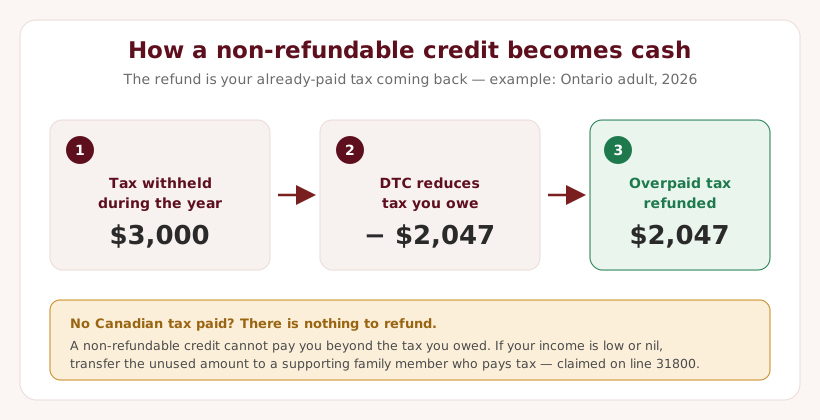
The federal credit is up to $1,448 for 2026, with provinces adding more (see the 2026 rates and province hub, or the calculator). But the DTC is non-refundable, it cannot refund tax you never paid. That is the heart of the student strategy.
Priya, a full-time master's student. Priya is a tax resident with a part-time campus job and only about $600 of tax withheld all year. Her approved DTC is worth far more than $600, but a non-refundable credit cannot refund tax she never paid, so she recovers her $600 and the rest of the credit has nowhere to go on her own return.
The fix, a transfer. If Priya depends on a parent or spouse who is also a Canadian tax resident and pays tax, the unused disability amount can transfer to them on line 31800, turning the credit into a real refund for the household. If no eligible supporting person exists, the smarter play is to get approved now and claim going forward once she graduates and earns taxable income.
The mechanics of how a non-refundable credit becomes a refund are explained in plain terms on the pillar guide.
From study permit to PGWP: when the DTC becomes more valuable
For many students the DTC pays off most after graduation. On a Post-Graduation Work Permit (PGWP), you typically remain a Canadian tax resident and your income rises sharply, often from a few thousand dollars of part-time pay to a full salary. Suddenly there is real tax for the credit to reduce.
That is why approval during your studies is worth pursuing even if it produces little refund immediately. Once you are approved and earning, the credit reduces your tax every year, and you may also be able to claim retroactively for the study years you qualified as a resident (up to 10 years), using Form T1-ADJ, see our retroactive claims guide. The medical start date your practitioner records on the T2201 helps determine which earlier years CRA may review.
Co-op, TA/RA income, and scholarships: what counts
Students often have an unusual income mix, and it affects how much of the DTC they can use directly:
- Co-op and internship earnings are employment income and are taxable, so they create tax the DTC can offset.
- Teaching assistant (TA) and research assistant (RA) pay is generally employment income, also taxable.
- Scholarships, fellowships, and bursaries for students enrolled in a qualifying program are often exempt from tax, which means they usually do not create tax for the DTC to reduce.
The practical takeaway: the more of your income that is taxable employment income, the more of the DTC you can use yourself; the more it is exempt scholarship income, the more a transfer (or claiming later) is the better route.
Who can claim a student's DTC
Either the student, to the extent they have Canadian tax payable, or a supporting person the student depends on for a basic necessity of life who is a Canadian tax resident, via the s.118.3(2) transfer on line 31800. A parent living abroad with no Canadian return generally cannot absorb the transfer, the supporting person needs Canadian tax of their own.
Common mistakes students make
- Assuming a study permit means non-resident. Most degree students are residents for tax purposes.
- Skipping the application because income is low. Approval now sets up the transfer and future and retroactive claims.
- Using a foreign doctor's letter as the T2201. Part B must be completed by a Canadian-licensed practitioner.
- Forgetting to file a return at all. Filing, even with little income, is what puts you in the system to use or transfer the credit.
Can my doctor back home complete the form?
In practice, no. Under Income Tax Act s.118.4(2)(b), the certifier must be authorized where the taxpayer resides or in a province, and claiming the DTC requires Canadian tax residency, so arrange for a Canadian-licensed practitioner (campus health clinic, a family doctor, or nurse practitioner) to complete Part B. Your records from home are useful supporting evidence. Full detail is on the pillar guide.
Frequently Asked Questions
Yes, if the student is a resident of Canada for tax purposes, holds a SIN, and has a severe and prolonged impairment certified on Form T2201. Most degree students are tax residents.
No. Tax residency is based on residential ties, not permit type. Most international students completing a degree are residents for tax purposes.
Not necessarily. Transfer the unused amount to a supporting parent or spouse who pays tax, or claim it once you earn, including after graduation on a work permit.
An ITN lets you file a return, but the DTC application is built around the SIN. If you are not SIN-eligible, confirm DTC handling with the CRA before applying.