
Quick Answer
Most work permit holders who live and work in Canada are residents for tax purposes, hold a SIN, and pay Canadian income tax. With an approved Form T2201 they can claim the Disability Tax Credit, and the credit may reduce tax payable or support a reassessment, depending on tax paid and approved years. The type of work permit and the employer do not affect tax residency.
The short answer
Most work permit holders who live and work in Canada are tax residents, hold a SIN, and pay Canadian income tax. With an approved T2201, they can claim the DTC, and the credit may reduce tax payable or support a reassessment, depending on tax paid and approved years.
Your residency status
A work permit does not determine Canadian tax residency. CRA considers residential ties and the circumstances of your stay. A home, spouse or dependants in Canada can be relevant, but working full-time is not enough to decide status by itself. If your position is uncertain, review CRA's residency guidance and consider Form NR74. See our tax residency guide for newcomers.
2026 rates you can actually use
The federal disability amount for 2026 produces a federal credit of up to $1,448, and provinces add their own, bringing the combined value to roughly $2,000 to $3,700 a year depending on residence (for example about $2,853 in Alberta, $1,978 in Ontario, $2,003 in British Columbia). See the 2026 DTC rates, the province hub, or run your numbers in the calculator.
How "non-refundable" becomes cash for a worker
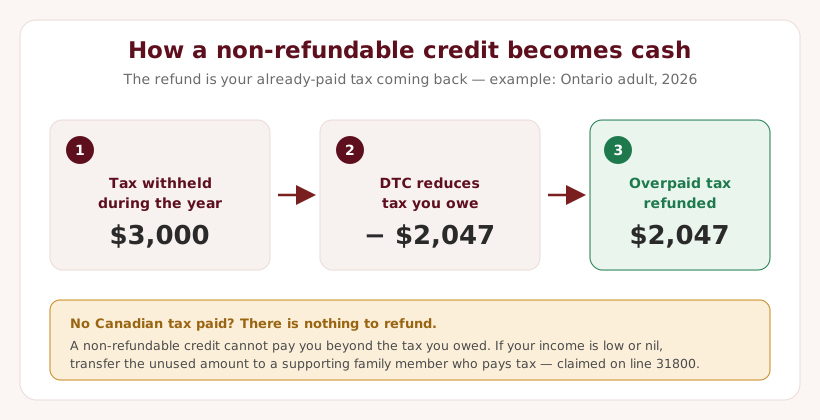
Because the DTC is non-refundable, the refund comes from tax you already paid through payroll (the mechanics are explained on the pillar guide). For a worker who pays tax, that is exactly the point.
Daniel, on a 3-year work permit in Ontario. Daniel earns $58,000 and had about $8,200 of tax withheld through payroll over the year. His approved Ontario DTC (around $1,978) reduces his assessed tax. Because he prepaid $8,200 through withholding, the credit returns about $1,978 as a refund when he files. If his spouse depends on him and cannot use her own credit, a transfer could add more.
A multi-year retroactive example
Retroactive claims are where work permit holders often recover the most, because they have been paying Canadian tax for years. Suppose Daniel was actually approved with a medical start date three years earlier, covering tax years he was already a resident and paying tax in Ontario:
Year 1 (current): $1,978 credit applied
Year 2 (T1-ADJ adjustment): $2,000 refund
Year 3 (T1-ADJ adjustment): $2,000 refund
Approximate total: $6,000 across three resident years
Each prior year is adjusted with a separate Form T1-ADJ once the T2201 is approved. The lookback runs up to 10 years, but only the years you were a Canadian tax resident with tax payable produce a refund. See our retroactive DTC claims guide for the full process.
Spousal transfer if your partner cannot use the credit
If your spouse or common-law partner is the person with the impairment but has little or no Canadian income, their unused disability amount can transfer to you, the working partner, on line 31800 under Income Tax Act s.118.3(2). For a one-income household on a work permit, this is a common and valuable scenario: the credit that the lower-income spouse cannot use lands on the higher-income return where there is tax to reduce.
Leaving Canada: what happens to your DTC?
Work permits end, and many holders eventually leave or transition status. A few points worth knowing:
- In the year you emigrate, you are usually a part-year resident, and you can claim the DTC for the part of the year you were a Canadian tax resident with tax payable.
- Years you already qualified as a resident remain claimable retroactively even after you leave, within the 10-year window.
- If you become a permanent resident instead of leaving, nothing about your DTC resets, your approval and history carry forward.
Because the departure year mixes resident and non-resident periods, it is worth a professional review to claim correctly.
DTC vs the Canada Disability Benefit
The DTC is a tax credit. The Canada Disability Benefit is a separate program, and for temporary residents it requires 18 months of temporary residence plus DTC approval. Being DTC-approved does not automatically grant the Canada Disability Benefit, do not assume one follows the other.
Can a doctor from my home country certify the form?
The practitioner's authorization and professional category matter, rather than the country of diagnosis alone. CRA requires the certifier to be authorized under the laws of the jurisdiction where the person being certified resides, or under the laws of a Canadian province. Overseas medical records can support the application, but do not by themselves establish that their author can certify Part B. Confirm uncertain cases with CRA and review the CRA certification requirements and our T2201 form guide.
Frequently Asked Questions
Yes, if the worker is a resident of Canada for tax purposes, holds a SIN, and has a severe and prolonged impairment certified on Form T2201. Most work permit holders who live and work here are tax residents.
No. Tax residency depends on residential ties, not permit type or employer. Open and closed permits are treated the same for DTC purposes.
If you paid Canadian income tax during the year, the DTC reduces your assessed tax and the over-withheld amount is refunded. Workers who pay tax commonly receive a real refund.
No. It is a separate program with its own rules, including an 18-month temporary-residence requirement plus DTC approval.