
Quick Answer
The Disability Tax Credit can still be relevant for families with a parent or grandparent on a super visa, but the claim depends on Canadian tax residency, a SIN, and an approved Form T2201. A pure visitor stay usually is not enough, while deemed residents or future permanent residents may have options. Start by checking residency first, then eligibility and transfer rules.
The short answer
A super visa does not automatically open a DTC claim, but it is still worth understanding the rule before ruling anything out. The key test is tax residency: a parent usually needs to be a Canadian tax resident with a SIN and an approved Form T2201 before the credit can be claimed or transferred. The exceptions, sponsor angle, and next steps are covered below.
Why a visitor usually is not a tax resident
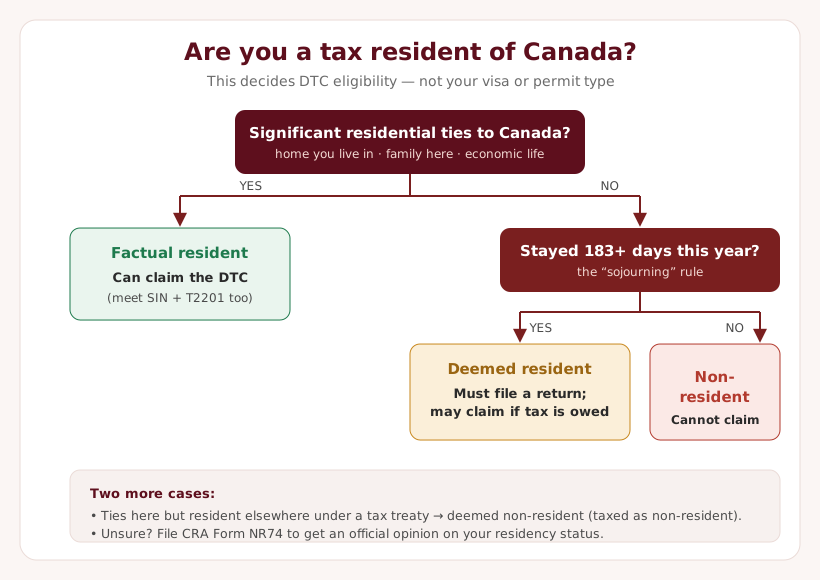
The DTC depends on tax residency, not visa type. Super visa parents typically keep their real home, spouse, and life in their origin country, so they are usually non-residents for Canadian tax purposes. Staying in Canada 183 days or more in a year can make a parent a deemed resident with a filing obligation. The full residency test (factual, deemed, non-resident, and treaty cases) is explained on our pillar guide: DTC for newcomers and temporary residents.
Who would actually claim the DTC for a parent?
Here is the question most families are really asking, and it is a smart one: the super visa already requires the host to prove income (the Low-Income Cut-Off, or LICO), so would that income not naturally produce a refund through the parent's disability?
Income is necessary, but not sufficient. For a refund to happen, all three of these must be true:
- The parent is a Canadian tax resident with an approved Form T2201, so a DTC actually exists.
- The parent cannot use the full credit themselves (low or no Canadian tax payable).
- The host qualifies as a supporting person, meaning the parent depends on them for a basic necessity of life (food, shelter, or clothing). This is the transfer rule in Income Tax Act s.118.3(2), claimed on line 31800.
While the parent is a pure visitor, there is no DTC to transfer, and the host's income alone changes nothing. The Canada Caregiver Credit is sometimes raised here, but it generally contemplates a dependant who is resident in Canada, so it is rarely available for a parent who is only visiting.
Worked example: Mrs. Sharma
Scenario A. Mrs. Sharma visits her son in Calgary for about 150 days each year, then returns to her home and husband abroad. She has no SIN. She is a non-resident and cannot claim the DTC, even with a qualifying impairment.
Scenario B. The next year she stays 210 days to recover from surgery. She may now be a deemed resident for that year and must file a Canadian return. But with no Canadian income and no tax payable, a non-refundable credit still returns nothing, there is no tax for it to reduce. (Why that is, in plain terms, is explained in our non-refundable credit explainer.)
The sponsor-income myth, explained
It is worth slowing down on this because it is the single most common misunderstanding. Suppose a host in Ontario earns $75,000, comfortably clears the super visa LICO requirement, and supports a visiting parent with severe arthritis. The host assumes that because they pay plenty of tax, the parent's disability should translate into a refund on the host's return.
It does not, not yet. The LICO requirement only proves the host has income capable of absorbing a credit. There is still no credit to absorb until the parent is a Canadian tax resident with an approved T2201. Sponsorship income is the engine, but tax residency is the ignition key, without it, the engine never starts. Once the parent does become a resident and is approved, that same host income is exactly what makes a transferred credit valuable.
If your parent becomes a permanent resident
This is the realistic path to a DTC for many families. If a parent is approved through the Parents and Grandparents Program (or otherwise becomes a permanent resident), they typically become a Canadian tax resident and obtain a SIN. At that point the normal DTC rules apply: a Canadian-licensed practitioner can certify the T2201, the parent can claim the credit, and any unused amount can transfer to a supporting child.
Importantly, once approved, the family may be able to claim retroactively for the years the parent qualified as a Canadian tax resident (up to 10 years), using Form T1-ADJ. Years spent purely as a visitor do not count, but residency years do. See our retroactive DTC claims guide.
Common mistakes families make
- Assuming the visa qualifies the parent. It does not, tax residency does.
- Claiming a visiting parent as a dependant for the DTC transfer. A non-resident parent usually has no DTC to transfer; an incorrect claim can trigger a reassessment.
- Submitting a foreign doctor's letter as the T2201. Part B must be completed by a Canadian-licensed practitioner.
- Confusing the DTC with the Canada Disability Benefit, which has its own 18-month temporary-residence rule and will not apply to a short-stay visitor.
Can their doctor back home certify the T2201?
In practice, no. Under Income Tax Act s.118.4(2)(b), the certifier must be authorized where the taxpayer resides or in a province, and claiming the DTC requires Canadian tax residency, so the CRA expects a Canadian-licensed practitioner. Foreign medical records are useful supporting evidence but cannot replace Part B. The full explanation is on the pillar guide.
Frequently Asked Questions
A super visa visit by itself is usually not enough. The DTC depends on Canadian tax residency, a SIN, and an approved Form T2201, so families should check residency first.
Staying 183 days or more can make a parent a deemed resident who must file a Canadian return, which could allow the credit, but only if there is Canadian tax to reduce.
Generally no. The transfer assumes the parent is a Canadian tax resident with an approved T2201 and therefore has a DTC to transfer. A non-resident visiting parent usually has none.
Once the parent is a Canadian tax resident with a SIN, the standard DTC rules apply, including the possibility of retroactive claims for years they qualified as a resident.